

Introduction to Multimodal Freight Transport in Iran
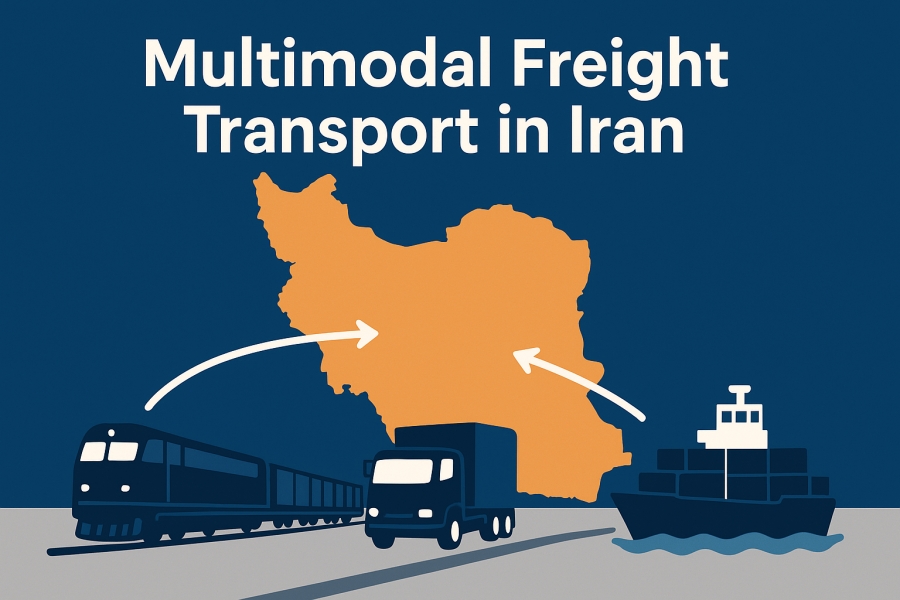
Multimodal freight transport in Iran refers to the integrated movement of goods using two or more modes of transport—rail, road, and sea—under a single logistical framework. This approach enhances efficiency, reduces transit time, and provides flexibility for both domestic and international trade. By leveraging multiple transport modes, Iran can optimize cargo flow, lower costs, and improve reliability for logistics operators and businesses.
Iran occupies a strategic position in regional and international trade corridors, linking the Middle East with Central Asia, Europe, and South Asia. Its geographic advantage allows it to serve as a critical transit hub for both East‑West and North‑South trade flows. According to recent data, road-transit volumes reached approximately 14.3 million tons, a 54 % increase compared to the previous year. Additionally, freight volumes passing through Iran along the International North‑South Transport Corridor (INSTC) rose from 16.3 million tons in 2021 to 26.9 million tons in 2024, highlighting its growing role in regional logistics.
Overview of Iran’s Freight Transit Networks
Iran’s freight transit networks form the backbone of its multimodal logistics system, integrating rail, road, and sea routes to facilitate efficient cargo movement across international corridors. Below is an overview of the primary components: rail, road, and sea networks, along with major cargo transit routes.
Rail Networks in Iran: Core of Multimodal Freight Transport
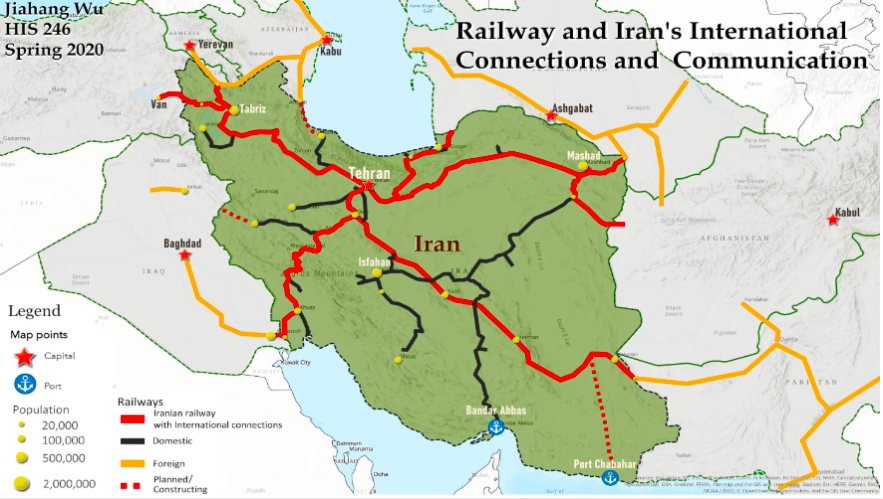
Iran’s railway system, managed by the Islamic Republic of Iran Railways (RAI), is a cornerstone of multimodal freight transport in Iran. It plays a critical role in Iran’s freight transit networks and multimodal cargo movement, especially for bulk transportation such as minerals, oil products, and containerized goods. Currently, the network spans approximately 13,500 kilometers of standard-gauge tracks, with planned expansions aiming to reach 25,000 kilometers, strengthening Iran’s cargo system.
Key lines include the historic Trans-Iranian Railway, a UNESCO World Heritage site, connecting the Persian Gulf ports to the Caspian Sea ports while crossing mountains, deserts, and diverse terrains.
The completion of the 37-kilometer Rasht-Caspian rail link in 2024 significantly enhances connectivity to northern ports like Bandar Anzali and Amirabad, facilitating trade with Russia and Central Asia and improving cargo transit routes in Iran.
Moreover, the ongoing China-Iran rail corridor drastically reduces transit times from 30–40 days by sea to just 15 days by land, boosting intermodal freight in Iran along Eurasian trade routes. Rail freight continues to expand, with international connections to Turkey, Azerbaijan, and Turkmenistan reinforcing the country’s freight network and logistics operations in Iran.
For a deeper look into the rail system and its role in multimodal transport services in Iran, see our detailed article: [Iran’s Railway Transport].

Sea Networks in Iran: Enhancing Multimodal Freight Transport
Iran’s maritime infrastructure, managed by the Ports and Maritime Organization (PMO), forms a crucial component of multimodal freight transport in Iran. With over 20 commercial ports along the Persian Gulf, Gulf of Oman, and Caspian Sea, these facilities support Iran’s freight transit networks and intermodal freight in Iran, handling diverse cargo types from containers to bulk commodities.
The largest port, Shahid Rajaee Port in Bandar Abbas, manages nearly 80% of the country’s container throughput, serving as the main gateway for imports and exports. Other key ports include Imam Khomeini Port for grain and petrochemicals, Chabahar Port on the Gulf of Oman for access to Afghanistan and Central Asia, and Caspian Sea ports such as Amirabad and Bandar Anzali, facilitating trade with Russia and Kazakhstan.
In the Iranian year ending March 2025, ports processed 234.8 million tons of cargo, with August 2025 alone accounting for 12.8 million tons. Despite geopolitical challenges, including tensions in the Strait of Hormuz, Iran’s ports maintain vital cargo transit routes and integrated transport systems in Iran, offering feeder services to global hubs and linking efficiently with overland routes for multimodal cargo movement.
For more details on maritime freight and its role in multi modal transport services in Iran, read our full article: [Sea Shipping through Iran].

Road Networks in Iran: Backbone of Multimodal Freight Transit
Road transport dominates multimodal freight transport in Iran, accounting for over 90% of domestic and transit cargo due to its flexibility and extensive coverage. Iran’s national road network spans approximately 223,485 kilometers, including 2,793 kilometers of highways and 45,170 kilometers of main and primary roads, forming a key part of Iran’s freight transit networks and cargo transit routes in Iran.
Major highways, such as the Persian Gulf Highway (Freeway 7) connecting Tehran to southern ports like Bandar Abbas, and routes linking Mashhad in the east to western borders with Iraq and Turkey, are crucial for truck-based cargo transit. These roads also play a significant role in the North-South Transport Corridor (INSTC), facilitating international trade between the Persian Gulf, Caspian Sea, and Central Asia, and strengthening Iran’s cargo system.
In the first seven months of the Iranian year 1404 (ending October 2025), over 9.49 million tons of transit cargo were handled via the road network, reflecting consistent growth in freight volumes. Investments in infrastructure, including the opening of 840 kilometers of new highways, aim to reduce bottlenecks and enhance safety for heavy-duty vehicles. By integrating seamlessly with rail and sea networks, Iran’s road system supports efficient intermodal freight in Iran and multimodal cargo movement.
For a detailed overview of Iran’s road-based logistics and its connection to multimodal operations, see: [Overview of Road Transport via Iran].
Iran Freight Transit Networks and Cargo Transit Routes
Iran's integrated freight transit networks leverage its geographic position to host several major cargo routes, enhancing its role as a logistics hub. The flagship International North-South Transport Corridor (INSTC), a 7,200-kilometer multimodal pathway, connects India and the Gulf to Russia and Europe via three branches: the Western route (rail/road through Azerbaijan), Central route (via the Caspian Sea), and Eastern route (through Central Asia).
Other significant routes include the East-West Corridor, linking Central Asia to Europe via Iran's southern ports and roads, and emerging paths like the Russia-Kazakhstan-Turkmenistan-Iran rail route, which saw its first scheduled freight train arrive in November 2025 after a 12-day journey.
These routes reduce transit times by up to 50% compared to traditional sea paths through the Suez Canal, offering cost savings and reliability for commodities like oil, grains, and manufactured goods. Ongoing investments, including Caspian Sea cargo expansions targeting over five million tons annually, underscore Iran's ambition to anchor Eurasian trade flows.
Opportunities in Multimodal Freight Transport in Iran
For businesses looking to optimize global supply chains, multimodal freight transport in Iran offers compelling advantages as a regional and international transit hub.
Strategic Geographic Location
Strategic Geographic Location
Iran sits at the crossroads of the Middle East, Central Asia, and Europe. Companies can leverage its location to reduce transit times and access both regional and international markets efficiently.
Integration with International Corridors
Iran’s involvement in the International North–South Transport Corridor (INSTC) and connection to the Belt and Road Initiative (BRI) provides businesses with faster, cost-effective routes linking Russia, India, China, and Central Asia.
Growing Trade with Key Partners
Expanding trade with countries like China, Russia, and India drives reliable demand for transit services. Companies can leverage established cargo transit routes in Iran for predictable, high-volume logistics operations, while engaging Iran multimodal transit companies for streamlined service.
Cost Efficiency Through Mode Integration
Integrating rail, road, and maritime transport enables businesses to optimize supply chains, lower shipping costs, and enhance flexibility for imports and exports. This efficiency makes multi-modal transport services in Iran particularly attractive for foreign trade.
Resource Export Opportunities
Iran’s abundant natural resources—including energy and minerals—provide high-value cargo options. Combined with integrated transport systems in Iran, these resources can reach regional and international markets efficiently, positioning Iran as a strategic partner for resource-based exports.
Challenges in Multimodal Freight Transport in Iran
While Iran offers significant opportunities, companies should be aware of potential challenges to ensure smooth operations:
Regulatory Complexity
Navigating customs procedures, tariffs, and local regulations can be complex. Businesses must allocate resources for compliance to avoid delays in multimodal cargo movement in Iran.
Infrastructure Limitations in Certain Areas
While major ports and rail lines are modernized, some road or secondary rail links may lack capacity or maintenance, affecting transit reliability.
Geopolitical and Regional Risks
Tensions in the Persian Gulf, border regions, or political fluctuations can impact freight flows. Contingency planning is essential for companies using Iran’s freight transit networks.
Coordination Across Transport Modes
Effective multimodal transport requires seamless integration between rail, road, and sea. Misalignment between operators or infrastructure can lead to delays or increased costs.
Seasonal and Environmental Challenges
Harsh winters in northern regions or desert conditions in central Iran can disrupt transport schedules, especially for time-sensitive cargo.
Future Outlook of Multimodal Freight Transport in Iran
The future of multimodal freight transport in Iran is shaped by ongoing infrastructure expansion, international collaborations, and technological advancements. By 2030, Iran aims to extend its rail network beyond 25,000 kilometers, modernize key ports like Bandar Abbas and Chabahar, and integrate advanced digital logistics systems, improving efficiency across Iran’s freight transit networks. Strategic projects under the International North–South Transport Corridor (INSTC) and Belt and Road Initiative (BRI) are expected to further reduce transit times and increase cargo volumes, particularly for high-value goods and energy exports.
Emerging opportunities in smart logistics, intermodal hubs, and regional trade agreements will enable foreign businesses to capitalize on shorter, cost-effective routes connecting Asia, Europe, and the Middle East. As Iran multimodal transit companies adopt innovative solutions, companies can expect enhanced reliability, transparency, and operational flexibility, making Iran an increasingly strategic gateway for international trade.
SASCO: Your Strategic Partner for Multimodal Freight Transit in Iran
As a leading Iran multimodal transit company, SASCO offers comprehensive solutions to navigate the complexities of multimodal freight transport in Iran. Experienced in managing rail, road, and maritime networks, the company helps international businesses overcome regulatory, logistical, and infrastructure challenges while ensuring timely and secure cargo delivery.
With proven expertise as a reliable freight forwarder, SASCO acts as a strategic logistics partner for seamless trade across Iran and beyond, supporting companies that seek dependable, integrated, and flexible transit solutions.